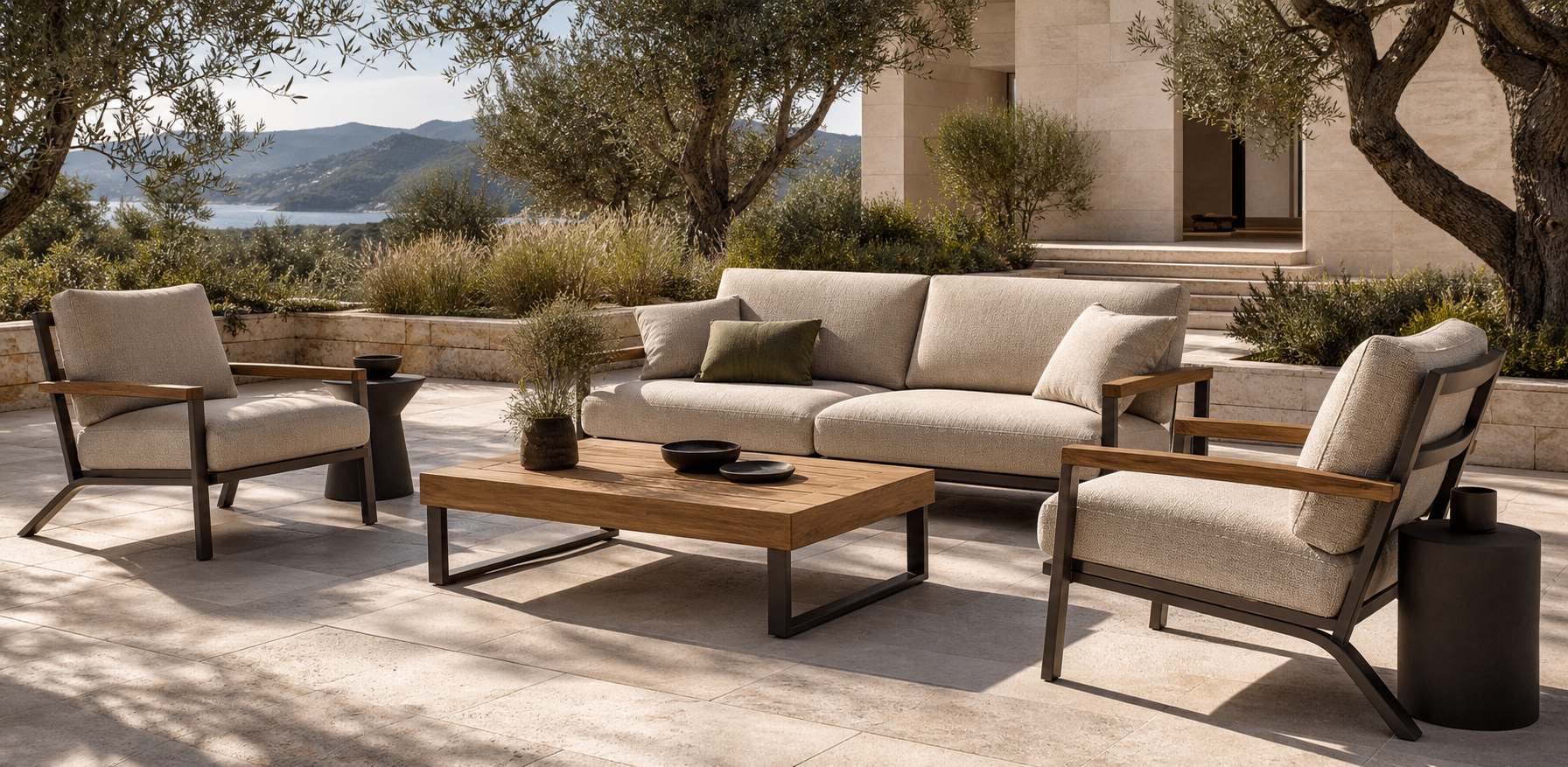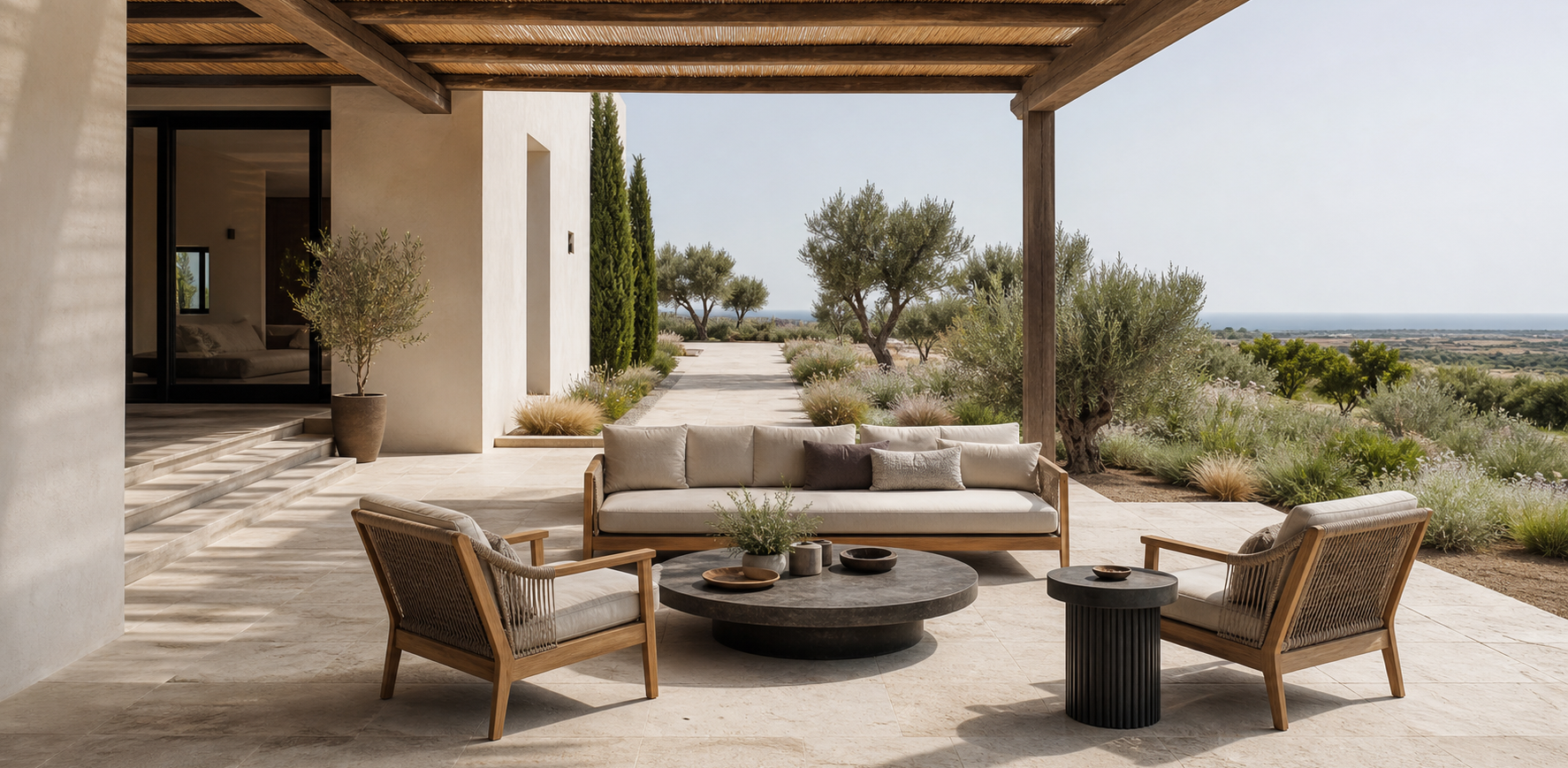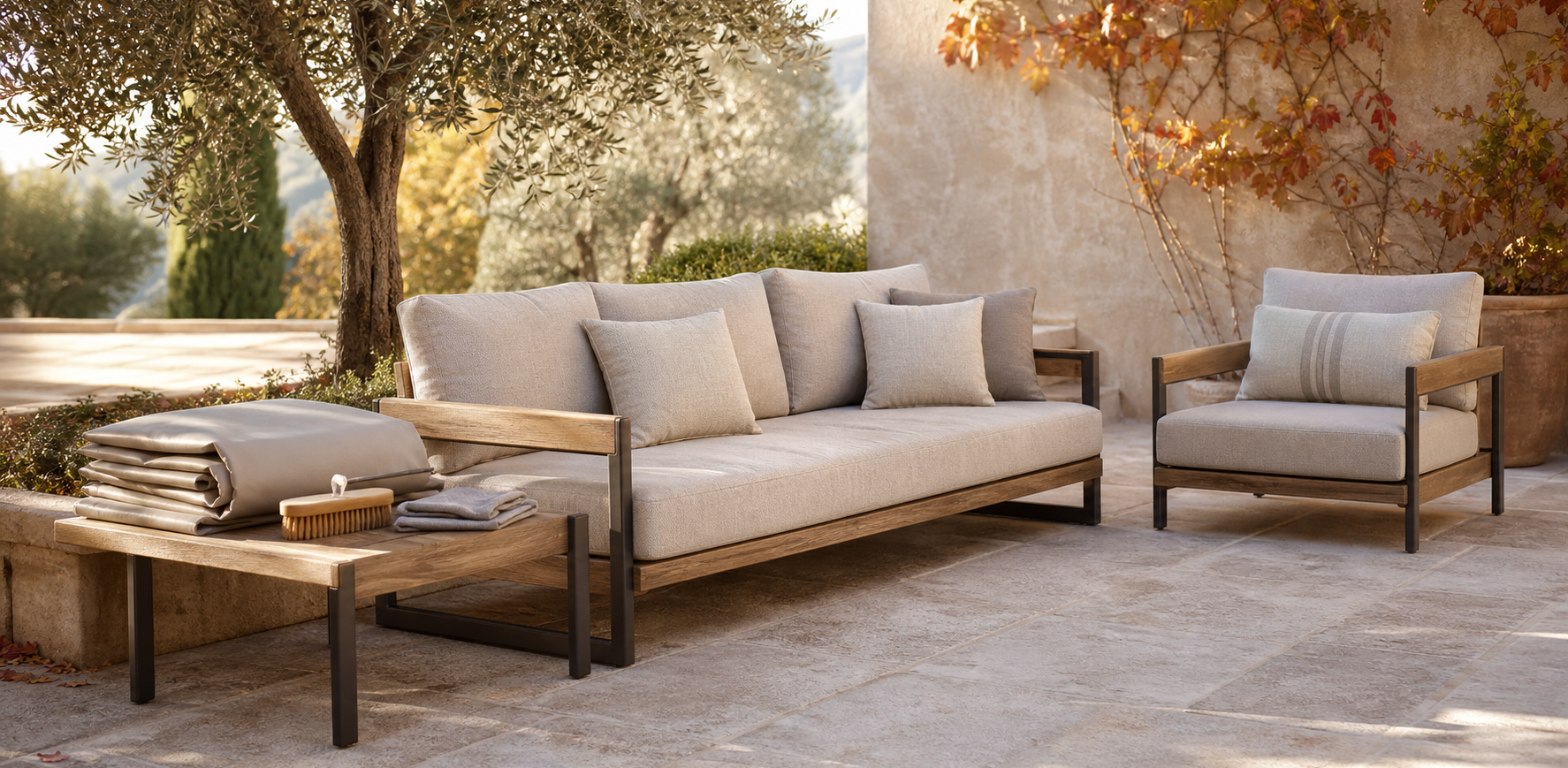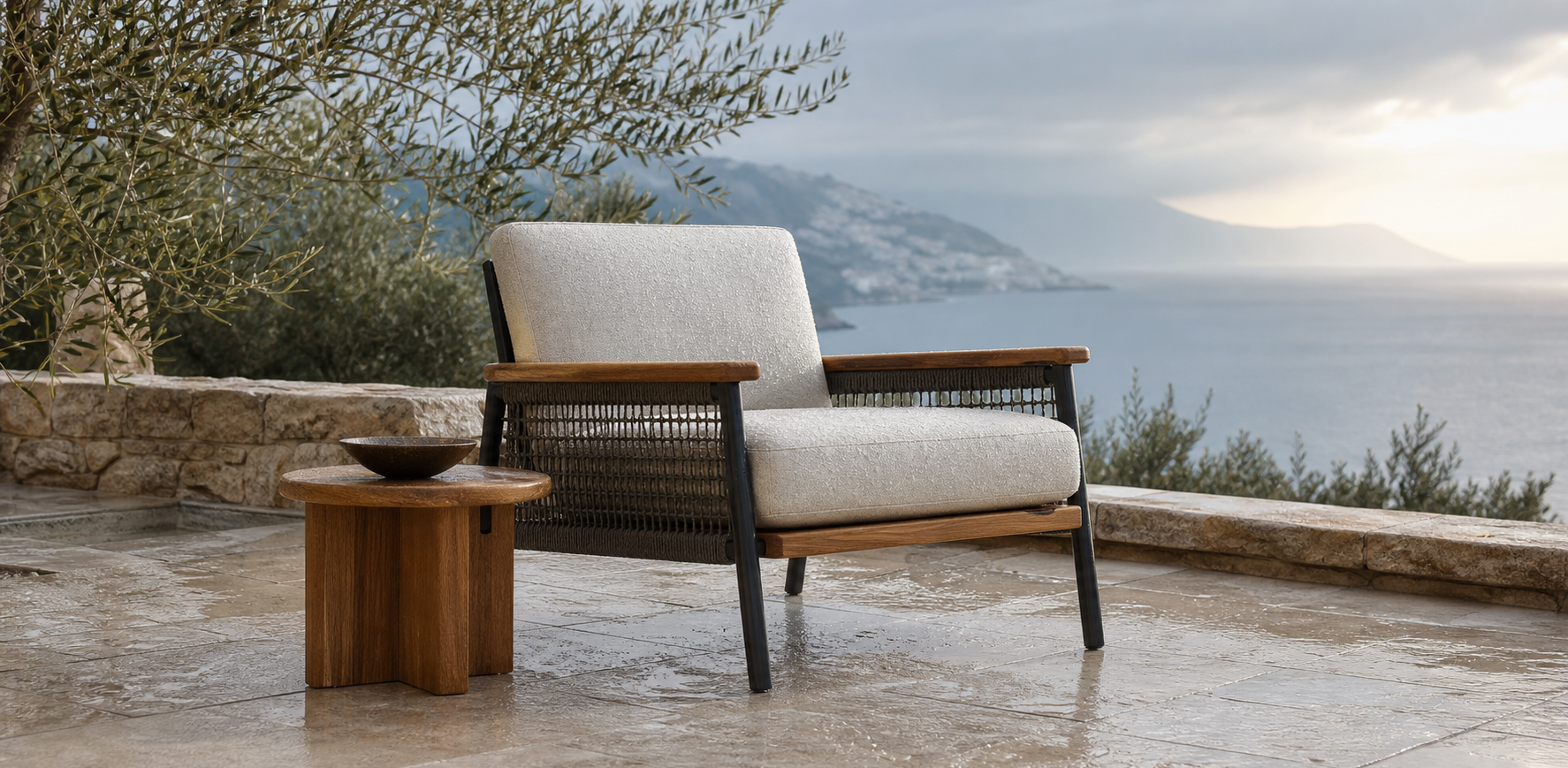
Outdoor furniture lives under conditions that indoor furniture never has to negotiate. Sunlight changes color, rain finds weak joints, salt settles on metal, and moisture remains inside cushions long after the surface appears dry. The material that looks most impressive in a showroom is not automatically the one that will age best on your terrace.
A better choice begins with exposure, construction, and the kind of maintenance you are willing to provide. This guide looks beyond broad labels such as “weatherproof” and explains what to inspect in wood, metal, woven fiber, fabric, and cushion systems. For the wider buying process, begin with How to Choose Outdoor Seating That Lasts.
Begin With Exposure, Not Appearance
Two terraces in the same city can place very different demands on furniture. A covered balcony may receive little rain but hours of reflected heat. A coastal garden may stay cool while salt carried by the air collects on every surface. A shaded courtyard can expose furniture to long periods of humidity even when direct rainfall is limited.
Before choosing a frame or textile, note the conditions that repeat through the year:
How many hours of direct sun reach the furniture in summer?
Does rain drain away quickly, or can water collect around the feet?
Is the space exposed to salt air, pool chemicals, heavy pollen, or urban pollution?
Can cushions dry in moving air, or does the terrace remain enclosed and humid?
Will the furniture stay outside through winter, or can it be moved under cover?
These answers establish the real performance brief. They also help distinguish graceful weathering from premature failure. A silver teak surface can be a natural change; a loose joint, trapped moisture, or lifting finish is not.
Understand How Teak and Other Woods Age
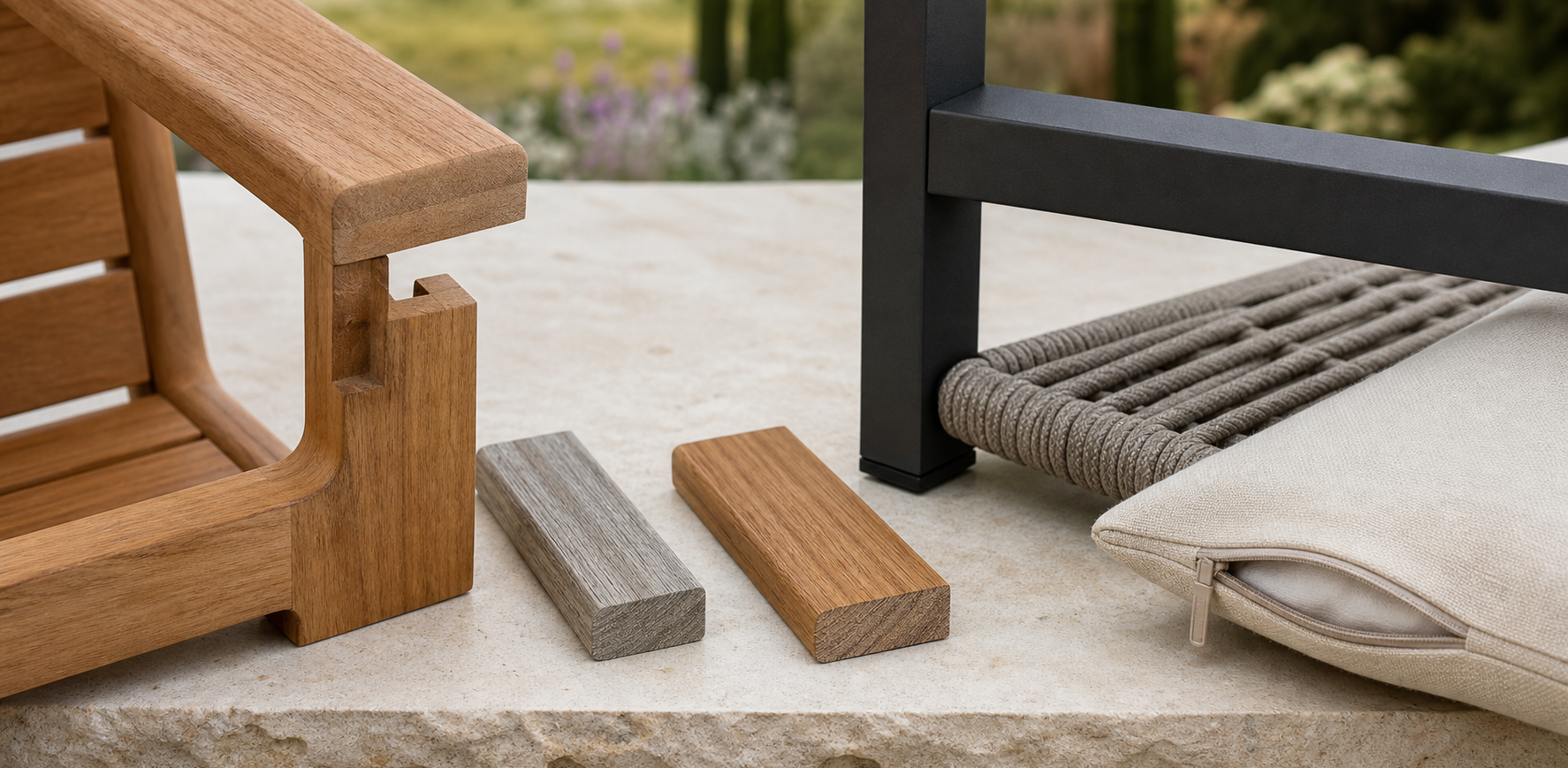
Teak is valued outdoors because its natural oils and dimensional stability help it tolerate changing weather. Left untreated, it usually shifts from warm honey brown toward a soft silver gray. That color change is largely aesthetic. Owners who prefer the original tone can clean and refinish the surface periodically, while those who accept the patina can follow a simpler routine.
Species alone does not guarantee quality. Look for consistent grain, smoothly eased edges, and joints that fit without wide gaps. End grain should not sit where it can continuously absorb standing water. Hardware should be accessible, and long spans should have enough support to avoid movement under load.
Other outdoor woods can perform well when their density, treatment, and construction suit the climate. Ask where the wood comes from, how it was dried, and which finish is used. Responsible sourcing is part of durability: the Vantaro Terra sustainability approach connects material origin, repairability, and a longer useful life.
Choose Metal by Finish and Construction
Powder-coated aluminum is a practical choice for many outdoor settings. It is lighter than steel, naturally resistant to corrosion, and easy to reposition. Quality depends on preparation and finishing: the coating should be even around welds and edges, and drainage holes should allow water to leave hollow sections instead of remaining inside.
Stainless steel brings a precise architectural character and considerable strength, but it still benefits from regular cleaning, especially near the sea. Tea staining on the surface is not the same as structural corrosion, yet it becomes harder to remove when salt and contamination are allowed to build up. Choose an appropriate stainless grade for the setting and avoid mixing incompatible metals where moisture can remain.
Painted or coated steel can also work in sheltered environments, but scratches deserve prompt attention. Whatever the metal, inspect the underside as carefully as the visible face. Protected fasteners, clean welds, replaceable glides, and open drainage paths reveal more about longevity than a flawless showroom finish.
Use Woven Fiber and Stone With Intention
Synthetic outdoor fibers can provide the warmth and texture of natural rattan without the same sensitivity to moisture. A strong weave remains consistent around corners, returns to shape after pressure, and is tensioned evenly against the frame. Loose ends, abrupt color changes, and unsupported wide sections are signs to examine more closely.
Natural stone and ceramic surfaces bring weight and permanence to tables, but “stone” is not a single behavior. Porosity, finish, thickness, and edge construction all matter. Some surfaces benefit from sealing; others require little more than mild cleaning. Dark stone can become uncomfortable in intense sun, while very light porous stone may show stains quickly. Ask for care guidance for the exact material rather than following a universal rule.
Mixed-material furniture succeeds when every component can move, drain, and age at a compatible rate. A durable tabletop does not compensate for a frame that traps water, and a strong frame cannot protect a poorly supported weave.
Judge Fabrics and Cushion Cores as One System
Outdoor upholstery must balance softness with resistance to sunlight, moisture, staining, and repeated cleaning. Useful questions include whether the color is carried through the fiber, whether the cover is removable, and what cleaning method the manufacturer specifies. Neat seams, protected zippers, and replaceable covers make long-term ownership easier.
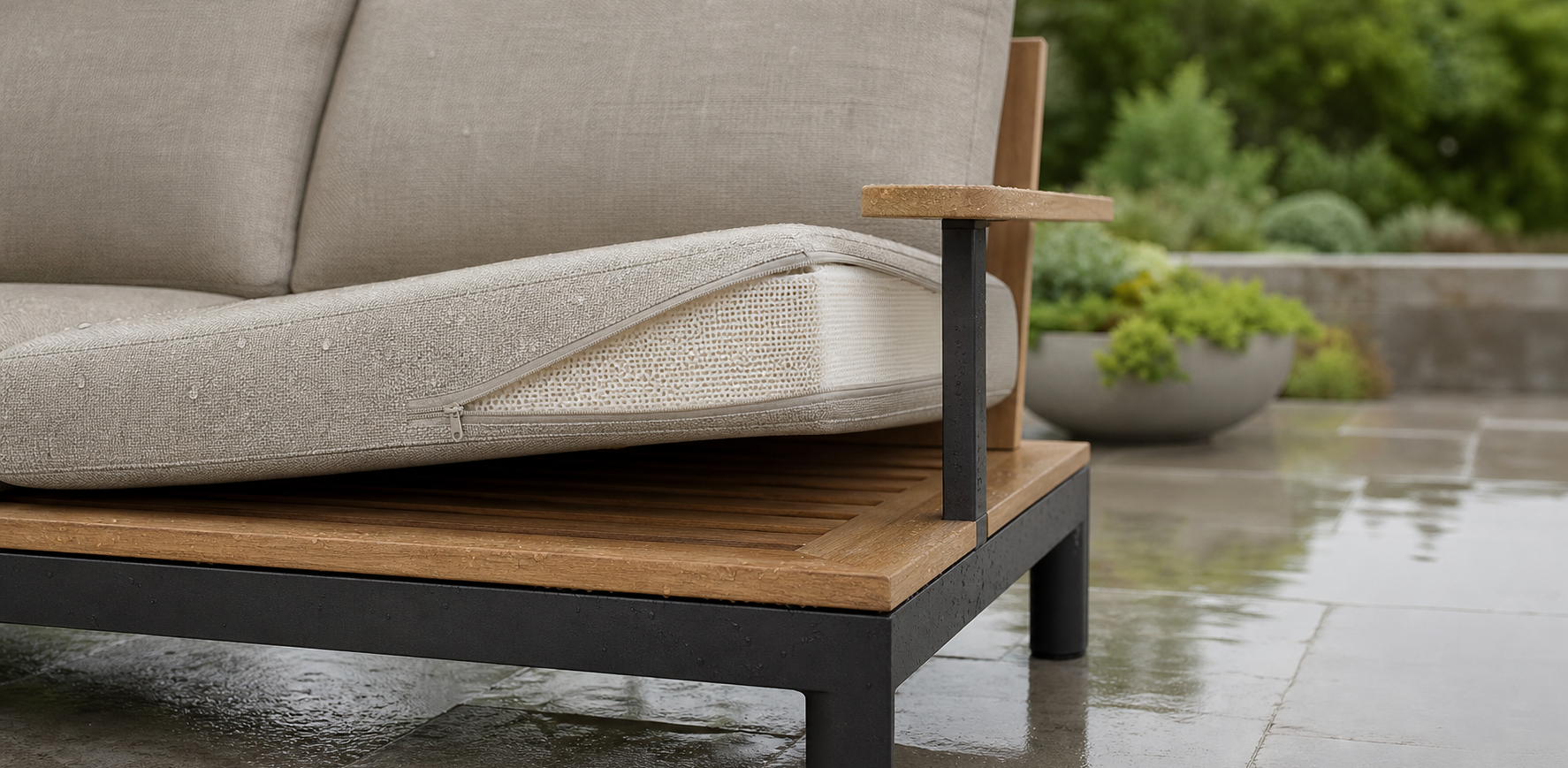
The material inside the cover is equally important. A cushion should release water and regain its shape rather than holding moisture at the center. Ventilated or quick-drying cores, open furniture bases, and room for air to circulate work together. Even a high-performance textile can develop problems if it surrounds a saturated core on a solid base.
Press the cushion and check whether it recovers evenly.
Inspect the underside for mesh, vents, or another clear drainage route.
Confirm that covers can be removed without forcing the zipper or foam.
Ask whether replacement covers and individual cushions can be ordered later.
Look for a Repairable Furniture System
Durable materials are most valuable when the furniture is designed to be maintained. Replaceable glides protect both the frame and the floor. Accessible fasteners allow a joint to be tightened. Separate covers, cushions, slings, and woven panels prevent one worn component from ending the life of the whole piece.
Before buying, request care instructions and ask which replacement parts remain available. Consider the weight of each piece, whether it needs seasonal storage, and how easily it can be moved without dragging. Then plan the arrangement with How to Plan an Outdoor Seating Layout That Feels Effortless.
No outdoor material is maintenance-free, but the right combination should make care predictable rather than demanding. The companion guide How to Care for Outdoor Furniture Through Every Season turns these material differences into a simple routine. Choose components that suit the climate, inspect how they are joined, and favor systems that can be cleaned, repaired, and renewed over time.